AAA MOULD

AAA MOULD

3D Printing

Additive manufacturing

3D printed parts for design reviews, testing and short runs

3D printing builds parts layer by layer from the CAD file, with no tooling. It is the quickest way to get a part in your hand for a design review or a fit check, and it can make internal channels and lattice shapes that no cutter can reach.

The process is chosen from what the part has to do: look right, snap together, carry load or take heat. Support removal, sanding, painting and machining of critical holes are planned together with the print.

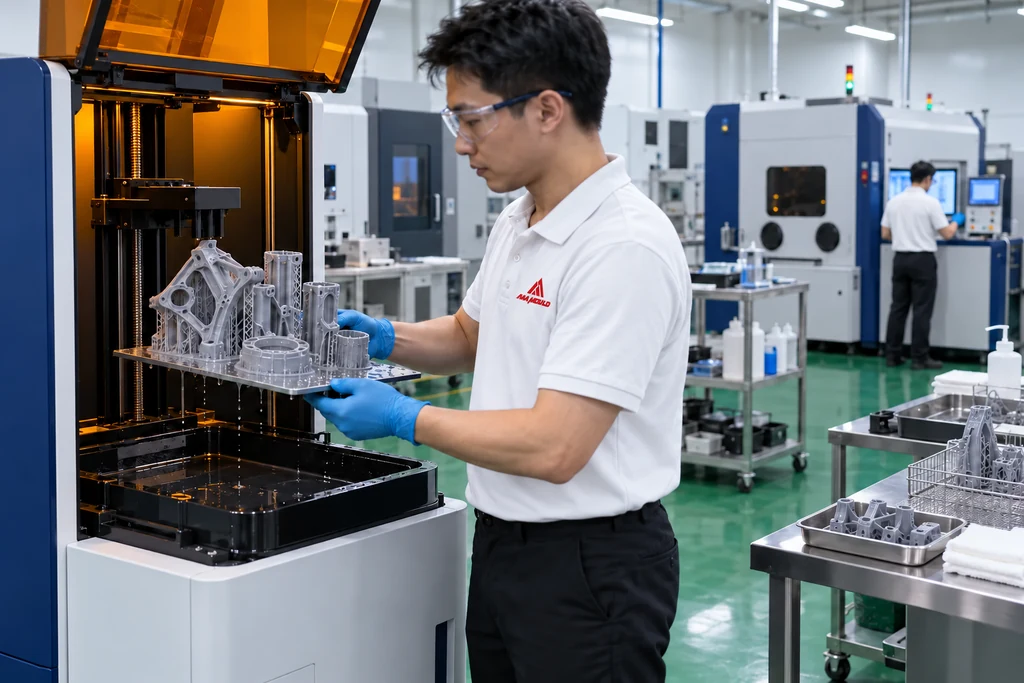
Technician removing an SLA build platform with printed parts from a stopped 3D printer
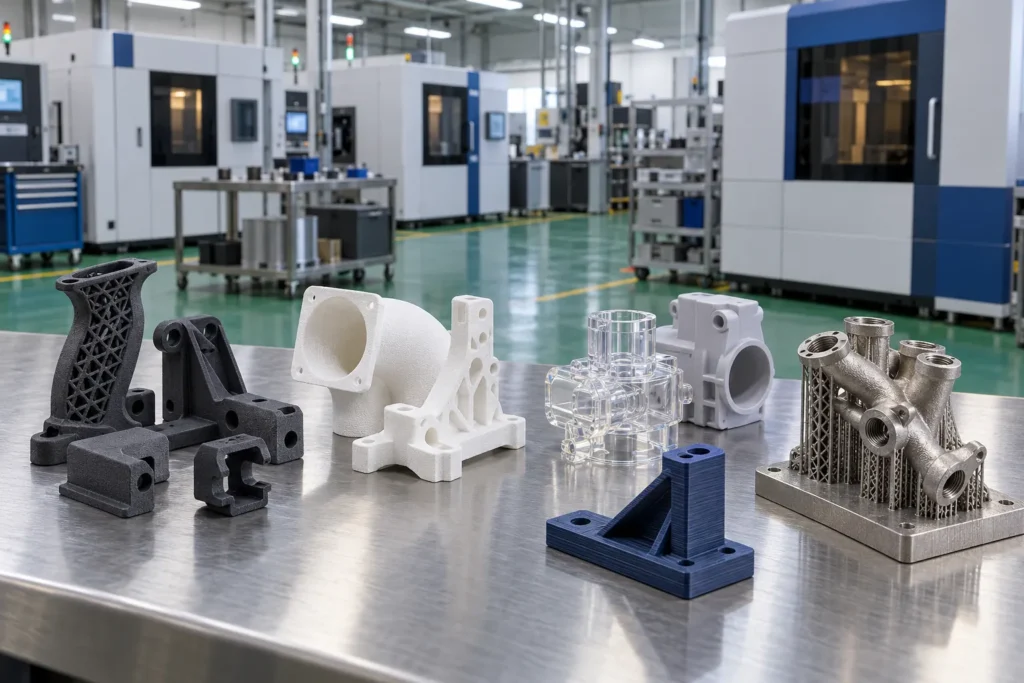
MJF, SLS, SLA, FDM and metal 3D printed parts on a bench

3D printing technologies

3D printing at a glance (typical)

TechnologiesFDM, SLA/DLP, SLS/MJF, PolyJet, SLM/DMLS metal printing, binder jetting
MaterialsPhotopolymer resins, nylon (PA12, PA11), thermoplastic filaments, metal powders
Layer thicknessSLA about 0.05–0.1 mm; SLS and MJF about 0.08–0.12 mm; FDM 0.1–0.3 mm; metal 0.02–0.06 mm
AccuracySLA, SLS and MJF about ±0.1–0.2 mm or ±0.2% on larger parts; FDM coarser
Best forConcept models, fit and function prototypes, complex geometry, short runs
Post-processingSupport removal, sanding, painting, machining of critical holes and faces

3D printing FAQ

Which 3D printing technology should I choose?

SLA for smooth, detailed appearance models and vacuum casting masters; SLS or MJF nylon for snap fits, ducts and other functional parts; FDM for large, low-cost models and fixtures; metal printing for metal parts with internal channels or shapes that cannot be machined.

Are 3D printed parts as strong as molded parts?

Usually not. Printed parts are weaker between layers, FDM parts most of all, and printing resins are not the same as molding grades. For production-like properties, consider CNC machining, vacuum casting or rapid tooling.

Have a drawing ready? Send it for a quotation.