

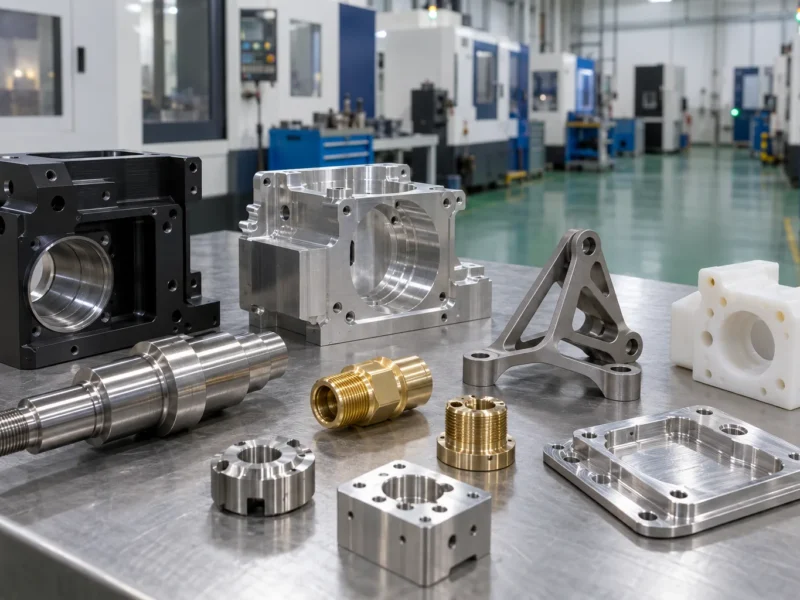
The price of a CNC machined part comes from a handful of factors. Knowing them helps you compare quotations and, more usefully, design parts that cost less to make without losing function.
The main cost drivers
| Driver | Why it matters |
|---|---|
| Material | Stock price, and how easily it machines: aluminum and brass cut fast; stainless steel, titanium and hardened steels are slower and wear tools. |
| Machine time | Set by the volume of material removed, the features and the cutting speed the material allows. |
| Setups | Every time a part is re-clamped to reach another face costs time and fixturing. Multi-axis machines reduce setups on complex parts. |
| Tolerances | Tight tolerances need slower finishing passes, more inspection and sometimes grinding. |
| Features | Deep pockets, small inside radii, thin walls, deep holes and fine threads need small tools and slow cuts. |
| Surface finish | Fine surface roughness, polishing or cosmetic requirements add operations. |
| Finishing | Anodizing, plating, painting and heat treatment are extra processes. |
| Quantity | Programming and setup are shared across the batch; the price per part falls as quantity rises. |
Ten ways to reduce cost
- Choose the cheapest grade that meets the requirement: 6061 aluminum instead of 7075 when strength allows, 303 stainless instead of 316 where corrosion allows, C360 brass for turned fittings.
- Apply tight tolerances only to features that need them; leave the rest to a general standard (see machining tolerances explained).
- Make inside corner radii at least one third of the pocket depth where possible, so a stiffer cutter can be used.
- Keep holes to about 4 times their diameter in depth where you can; deeper holes need peck or gun drilling. Avoid deep, narrow pockets.
- Keep walls at least about 0.8 mm thick in metal and 1.5 mm in plastic (typical); thinner walls vibrate and deflect.
- Use standard drill and thread sizes, and limit thread depth to about 1.5 to 2 times the diameter.
- Design features that can be reached from as few directions as possible.
- Specify cosmetic surfaces only where they show.
- Group parts into one order to share setup and shipping.
- At higher volumes, check whether casting or molding would be cheaper. For prototypes, see 3D printing vs CNC vs vacuum casting.
How to compare quotations
Check that each supplier quotes the same drawing revision, material grade, finish, inspection requirements and quantity. A lower price that leaves out the first article report, material certificates or finishing is not the same offer.
Frequently asked questions
Why is the first part so much more expensive than the tenth?
Programming, fixturing and first-article setup are needed once per batch. With one part they carry the whole cost; with ten they are shared.
Is aluminum always cheapest?
Often, because it cuts fast. But a simple part in low-carbon or free-machining steel can cost about the same, and the finish (anodizing versus plating or painting) can change the comparison.
Does 5-axis machining cost more per hour?
Usually the hourly rate is higher, but fewer setups can make the part cheaper overall when it has features on many faces.
Have a part to quote? Send your 3D model and drawing through our inquiry form. An engineer reviews it and replies with a quotation and any design suggestions.